
safety 1st thermometer manual
Safety 1st Thermometer Manual: A Comprehensive Guide
Welcome! This comprehensive guide details Safety 1st thermometers, offering insights into models like TH106, TH097, and Det-306.
It covers installation, operation,
and troubleshooting, alongside downloadable manuals and PDF instructions.
Explore temperature scales, battery management, cleaning procedures, and warranty details for optimal performance.
Find answers to frequently asked questions and access Safety 1st customer support resources.
Safety 1st has long been a trusted name in baby and child safety, and their thermometers are no exception. Designed with accuracy and ease of use in mind, Safety 1st thermometers provide parents with a reliable way to monitor their child’s temperature and ensure their well-being. From traditional digital thermometers to convenient forehead scanners, Safety 1st offers a variety of models to suit different needs and preferences.
This manual serves as a comprehensive resource for understanding and utilizing your Safety 1st thermometer effectively. Whether you’ve recently purchased a Simple Scan Forehead Thermometer (TH106), a Rapid Read 3-in-1 Thermometer (TH097), or another model, this guide will walk you through the essential features, proper usage techniques, and important safety precautions.
You’ll find detailed instructions on everything from battery installation and changing temperature scales to interpreting error codes and accessing warranty information. Safety 1st prioritizes providing parents with the tools and knowledge they need to confidently manage their child’s health, and this manual is a key component of that commitment. Downloadable manuals and PDF instructions are also readily available for your convenience.
Understanding Different Safety 1st Thermometer Models

Safety 1st offers a diverse range of thermometers, each designed with specific features to cater to varying needs. The Safety 1st Simple Scan Forehead Thermometer (TH106) provides a quick and non-invasive temperature reading, ideal for infants and young children. Conversely, the Rapid Read 3-in-1 Thermometer (TH097) offers versatility with oral, rectal, and axillary (underarm) measurement options.
For a more traditional approach, Safety 1st also provides basic digital thermometers, like the Baby’s 1st Digital Thermometer, offering reliable readings with a flexible tip for comfort. Other models, such as the Det-306, may include additional features like memory recall and fever indication. Understanding these distinctions is crucial for selecting the most appropriate thermometer for your family.
Each model has a dedicated user manual available for download, providing detailed instructions specific to its operation. These manuals, available as PDF instructions, cover everything from battery installation to interpreting readings. Familiarizing yourself with your specific model’s features and limitations, as outlined in its manual, will ensure accurate and effective temperature monitoring.
Safety Precautions & General Use

Safety 1st thermometers are designed for indoor use only. Always supervise children when using a thermometer and keep it out of their reach to prevent accidental ingestion of small parts, including the battery. Never use a thermometer if it is damaged, and avoid dropping it, as this can affect its accuracy.
Before each use, inspect the thermometer for any signs of wear or damage. Ensure the probe or sensor is clean and disinfected, following the cleaning instructions in your user manual. When taking a temperature, avoid using the thermometer immediately after eating, drinking, or physical activity, as this can influence the reading.

Always adhere to the recommended usage guidelines for your specific model, as outlined in the PDF instructions. Do not attempt to disassemble or modify the thermometer. For prolonged storage, remove the battery to prevent leakage and corrosion. Proper care and adherence to these precautions will ensure safe and reliable operation of your Safety 1st thermometer.
Temperature Scales: Fahrenheit vs. Celsius
Safety 1st thermometers often offer readings in both Fahrenheit (°F) and Celsius (°C). Understanding the difference is crucial for accurate temperature interpretation. Celsius is part of the metric system, widely used globally, where water freezes at 0°C and boils at 100°C. Fahrenheit, primarily used in the United States, sets the freezing point of water at 32°F and the boiling point at 212°F.
A temperature of 37°C is equivalent to 98.6°F, considered the average normal human body temperature. Your Safety 1st thermometer manual provides specific instructions on how to switch between these scales, often involving a button press or setting adjustment. Accurate conversion is vital for proper medical assessment.
Refer to your model’s PDF instructions for detailed guidance on changing temperature units. Incorrectly interpreting the scale can lead to misdiagnosis or inappropriate action. Familiarize yourself with the preferred scale used by your healthcare provider to ensure consistent communication and understanding of temperature readings.
Changing Temperature Units on Your Thermometer

Safety 1st thermometers provide flexibility by allowing users to switch between Fahrenheit (°F) and Celsius (°C). The process varies slightly depending on the specific model. Consult your Safety 1st thermometer manual for precise instructions tailored to your device – whether it’s the Simple Scan TH106, Rapid Read TH097, or another model like Det-306.
Generally, changing the unit involves pressing and holding a dedicated button, often labeled “Unit,” “°C/°F,” or similar. Some models require accessing a settings menu via button combinations. The display will briefly show the changing scale before settling on the new selection. Ensure the change is confirmed by observing the updated temperature reading.
Downloadable PDF instructions offer visual aids and step-by-step guidance. If you encounter difficulties, refer to the troubleshooting section of your manual or contact Safety 1st customer support. Accurate temperature readings depend on selecting the correct scale, so double-check your preference before each use.
Battery Installation & Replacement
Safety 1st thermometers typically require batteries for operation. The battery type varies by model – consult your specific manual (TH106, TH097, Det-306, etc.) for the correct size and quantity. Battery compartments are usually located on the back or within the handle of the device.
To install batteries, carefully open the compartment, observing the polarity markings (+ and -) inside. Insert the batteries accordingly. Ensure a secure fit. For replacement, remove the depleted batteries and follow the same installation procedure with fresh ones. Always dispose of used batteries responsibly, following local regulations.
Downloadable PDF manuals often include diagrams illustrating battery placement. A low battery indicator will alert you when replacement is needed. Using genuine Safety 1st recommended batteries ensures optimal performance. If the thermometer malfunctions after a battery change, double-check the polarity and battery contact points.
Low Battery Indicator & Troubleshooting
Safety 1st thermometers feature a low battery indicator, typically displayed as a flashing icon on the screen. This signals that the batteries need replacing to ensure accurate readings. Ignoring this warning can lead to unreliable temperature measurements.
If the thermometer displays inaccurate readings after a battery change, first verify correct battery polarity (+/-). Clean the battery contacts with a dry cloth to remove any corrosion. If the issue persists, try a different set of brand-new batteries. Download the relevant manual (TH106, TH097, Det-306) for model-specific troubleshooting steps.
For unresponsive units, confirm batteries are properly seated. Check for any physical damage to the thermometer or battery compartment. Refer to the PDF instructions available online for error code interpretations. If problems continue, consult the Safety 1st customer support resources or warranty information. Remember to remove batteries for long-term storage.

Using the Safety 1st Simple Scan Forehead Thermometer (TH106)
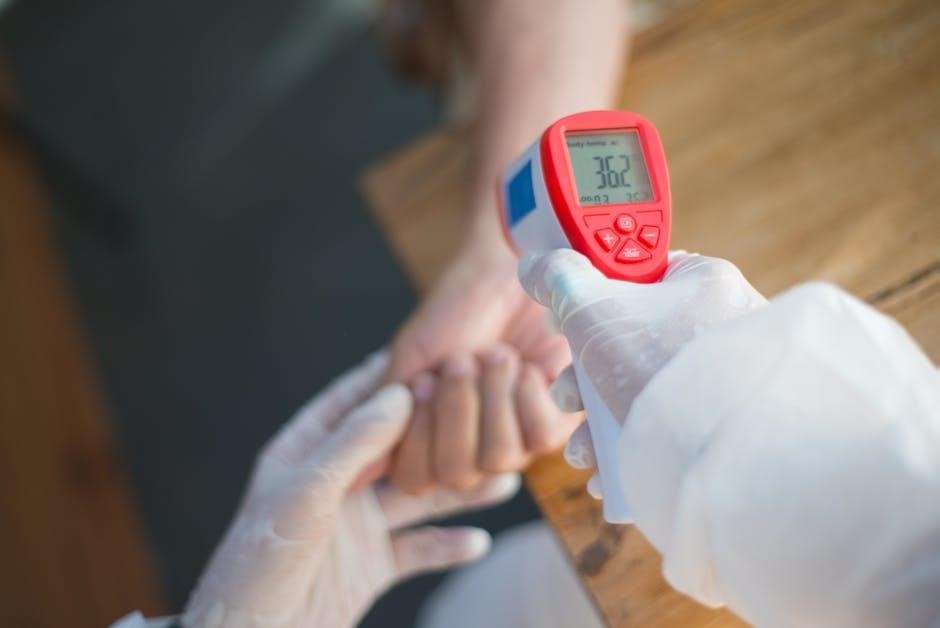
The Safety 1st Simple Scan Forehead Thermometer (TH106) provides a quick and convenient way to measure temperature. Ensure the lens is clean before each use. Power on the device and aim the thermometer at the center of the forehead, maintaining a distance of 1-3 centimeters (approximately 0.4-1.2 inches).
Press the scan button. The temperature will display on the screen within seconds. The TH106 is designed for ease of use, offering a non-invasive method for temperature checks. Refer to the user manual (Item No: TH106) for detailed instructions and understanding of display symbols.

Remember to consider environmental factors that might influence readings. For optimal accuracy, allow the thermometer to acclimate to room temperature before use. Download the complete PDF guide for comprehensive information, including troubleshooting and cleaning guidelines. Proper usage ensures reliable temperature monitoring for your family’s health.
Using the Rapid Read 3-in-1 Thermometer (TH097)
The Safety 1st Rapid Read 3-in-1 Thermometer (TH097) offers versatility with oral, rectal, and axillary (underarm) temperature-taking options. For oral use, place the probe under the tongue and close the mouth gently. Rectal use requires a lubricant and gentle insertion; this method is often preferred for infants. Axillary readings involve placing the probe in the armpit, ensuring skin contact.
Press the power button to activate the thermometer. The display will show the temperature within seconds. This model boasts a rapid reading time for quick and convenient checks. Download the manual for detailed instructions and safety precautions specific to each measurement method.

The TH097 comes with a one-year warranty. Proper cleaning and storage are crucial for maintaining accuracy and hygiene. Refer to the downloadable PDF guide (SKU: TH097) for comprehensive information on operation, maintenance, and troubleshooting. Always prioritize safety and follow the guidelines provided.
Using the Baby’s 1st Digital Thermometer
Safety 1st’s Baby’s 1st Digital Thermometer is designed for gentle and accurate temperature readings for infants and young children. This thermometer is suitable for oral, rectal, and axillary use, offering flexibility for different age groups and preferences. Always consult with a pediatrician regarding the most appropriate method for your child.
Before each use, ensure the thermometer is clean and functioning correctly. Press the power button to activate the device. Follow the on-screen prompts or refer to the user manual for specific instructions related to the chosen measurement method. The thermometer provides a clear digital display with temperature readings in Fahrenheit or Celsius (units can be changed – see section on unit conversion).
Downloadable PDF versions of the user guide are available online, offering detailed guidance on operation, cleaning, and troubleshooting. Proper care and maintenance will ensure the longevity and accuracy of your Baby’s 1st Digital Thermometer. Remember to store it in a safe, dry place.
Proper Cleaning and Disinfection
Maintaining hygiene is crucial when using any Safety 1st thermometer, especially for multiple users or with young children. After each use, thoroughly clean the thermometer probe with a soft cloth dampened with isopropyl alcohol (70% is recommended). Ensure the alcohol concentration is appropriate to avoid damaging the device.
Avoid immersing the thermometer body in water or any other liquid, as this can compromise its electronic components. Gently wipe the probe, ensuring all traces of bodily fluids are removed. For enhanced disinfection, particularly after use with someone experiencing illness, consider using a disinfectant wipe specifically designed for medical devices, following the manufacturer’s instructions.
Refer to your specific thermometer’s user manual for detailed cleaning guidelines. Downloadable PDF versions are available online. Proper cleaning not only prevents cross-contamination but also extends the lifespan and maintains the accuracy of your Safety 1st thermometer. Always allow the thermometer to dry completely before storing.
Storage Guidelines for Optimal Performance
To ensure the longevity and accuracy of your Safety 1st thermometer, proper storage is essential. Always store the device in a cool, dry place, away from direct sunlight and extreme temperatures. Avoid storing it in humid environments like bathrooms, as moisture can damage the internal components.
When not in use for extended periods, it’s highly recommended to remove the battery. This prevents potential corrosion from leakage, which could render the thermometer unusable. Keep the battery separate from the device. Store the thermometer in its original case, if available, to protect it from dust and physical damage.
Refer to your specific model’s manual for any unique storage recommendations. Downloadable PDF versions are readily accessible online. Following these guidelines will help maintain the reliability and performance of your Safety 1st thermometer, ensuring accurate readings when you need them most. Remember room temperature is ideal.
Troubleshooting Common Issues
Encountering problems with your Safety 1st thermometer? Here’s a guide to resolving common issues. If the display is blank, first check the battery – a simple replacement often solves the problem. Ensure the battery is installed correctly, observing the polarity markings. If the readings seem inaccurate, verify you’re using the correct temperature scale (Fahrenheit or Celsius).
For forehead thermometers, confirm the sensor lens is clean and unobstructed. Error codes, if displayed, require referencing the manual for specific meanings. Downloadable PDF versions are available online. If the thermometer isn’t powering on even with a new battery, there may be an internal fault.
Consult the manual for detailed troubleshooting steps specific to your model (e.g., TH106, TH097, Det-306). If issues persist, contact Safety 1st customer support for assistance. Remember to keep your model number handy when seeking support.
Error Codes and Their Meanings
Safety 1st thermometers utilize error codes to indicate specific malfunctions. Understanding these codes is crucial for effective troubleshooting. While codes vary by model (TH106, TH097, Det-306), common errors include “Lo” or “LL” signifying a low battery, requiring immediate replacement. An “Er” or “E” code generally indicates an internal system error, potentially needing professional attention.
Some models display “H” or “HH” for high temperature readings beyond the thermometer’s range. Ensure proper usage and environmental conditions. If a code appears repeatedly, consult your thermometer’s manual – downloadable PDF versions are readily available online. The manual provides a comprehensive list of error codes and their corresponding solutions.
Ignoring error codes can lead to inaccurate readings or device failure. Always address the issue promptly. If the manual doesn’t clarify the code, contact Safety 1st customer support, providing the specific error message and your thermometer’s model number.
Understanding Accuracy and Limitations
Safety 1st thermometers, including models like TH106, TH097, and Det-306, provide convenient temperature readings, but understanding their accuracy and limitations is vital. These devices aren’t substitutes for professional medical diagnoses. Accuracy can be affected by factors like improper usage, environmental temperature, and battery levels.
Forehead thermometers (e.g., TH106) are susceptible to interference from sweat, hair, or direct sunlight. Oral thermometers require correct placement and sufficient contact time. Always refer to the manual for specific instructions. Remember, readings are estimates and can vary slightly.
Limitations include the inability to detect internal body temperature directly. External readings offer an approximation. Regularly check the thermometer’s functionality and consult a healthcare professional for concerns. Downloadable PDF manuals detail accuracy specifications and potential sources of error. Prioritize professional medical advice for critical health assessments.

Warranty Information & Registration
Safety 1st stands behind the quality of its thermometers, including models TH106, TH097, and Det-306, with a limited warranty. The standard warranty period is 365 days from the date of purchase for the Rapid Read 3-in-1 Thermometer (TH097), as indicated in downloadable manuals. This warranty covers defects in materials and workmanship under normal use.
To initiate a warranty claim, retain your proof of purchase and contact Safety 1st customer support. The warranty does not cover damage resulting from misuse, accidents, or unauthorized repairs. Registration of your thermometer may be required to validate your warranty; check the included documentation or visit the Safety 1st website.
Detailed warranty terms and conditions are available in the product manual and on the official website. Registering your product ensures you receive important updates and notifications. Downloadable PDF versions of warranty information are readily accessible. Proper care and adherence to usage guidelines are essential for maintaining warranty validity.
Frequently Asked Questions (FAQ)
Q: How do I change the temperature scale? Refer to your specific model’s manual (TH106, TH097, Det-306) for detailed instructions. Typically, a button press allows toggling between Fahrenheit and Celsius.
Q: What does an error code mean? Consult the “Error Codes and Their Meanings” section of this guide or your product’s manual for explanations. Common codes indicate low battery or sensor issues.
Q: How do I clean the thermometer? Use a soft cloth dampened with isopropyl alcohol. Avoid immersing the unit in water. See “Proper Cleaning and Disinfection” for detailed steps.
Q: Where can I find downloadable manuals? Visit the Safety 1st website and search for your model number to access PDF versions of the user manual and other resources.
Q: What if my thermometer isn’t accurate? Ensure proper usage and calibration (if applicable). Contact customer support if accuracy concerns persist. Battery replacement may also resolve issues.
Safety 1st Thermometer Manual Downloads & Resources
Accessing Support is Easy! Safety 1st provides a wealth of online resources to enhance your thermometer experience. Downloadable PDF manuals are readily available for all models, including the Simple Scan Forehead Thermometer (TH106), Rapid Read 3-in-1 (TH097), and the Det-306.
Simply visit the official Safety 1st website and navigate to the “Support” or “Manuals” section. Utilize the search function, entering your specific model number (e.g., TH106, TH097) to locate the corresponding user guide. These manuals contain detailed instructions, troubleshooting tips, and warranty information.
Beyond manuals, explore frequently asked questions (FAQ) sections and video tutorials demonstrating proper usage and care. Safety 1st also offers dedicated customer support channels, including email and phone assistance, to address any concerns you may have. Ensure you have the model number handy when contacting support for efficient assistance.
Contacting Safety 1st Customer Support
Need Assistance? Safety 1st is committed to providing excellent customer support for all their thermometer products. If you encounter issues not addressed in the user manual or online resources, their dedicated support team is ready to help.
While specific contact details may vary, generally, you can reach Safety 1st customer support through their official website. Look for a “Contact Us” or “Support” link, typically found in the website’s footer. This section usually provides options for email inquiries and often a phone number for direct assistance.
When contacting support, be prepared to provide your thermometer’s model number (e.g., TH106, TH097, Det-306) and a detailed description of the issue you’re experiencing. Having your purchase date or warranty information readily available can also expedite the process. Safety 1st aims to resolve your concerns efficiently and ensure your satisfaction with their products.
Long-Term Storage Instructions (Battery Removal)
Preparing for Extended Storage? To ensure the longevity and optimal performance of your Safety 1st thermometer during prolonged periods of non-use, proper storage is crucial. A key step in this process is removing the batteries. Batteries can leak over time, potentially causing corrosion and damaging the internal components of your device.
Locate the battery compartment, typically found on the back or bottom of the thermometer. Carefully open the compartment and remove all installed batteries. It’s recommended to dispose of used batteries responsibly, following local regulations for battery recycling.
After battery removal, store the thermometer in a cool, dry place, away from direct sunlight and extreme temperatures. Avoid storing it in areas with high humidity. This will help prevent any potential damage and ensure your Safety 1st thermometer is ready for use when you need it again. Remember to remove batteries if storing for a long period of time!
Specific Model Guides (e.g., Det-306)
Navigating Your Specific Safety 1st Thermometer: Safety 1st offers a range of thermometers, each with unique features and operating instructions. This section highlights resources for specific models, ensuring you have the precise guidance needed for your device. For the Det-306 model, a comprehensive user manual is available for download, detailing installation, operation, maintenance, and troubleshooting steps.
Similarly, dedicated guides exist for the Simple Scan Forehead Thermometer (TH106) and the Rapid Read 3-in-1 Thermometer (TH097). These guides provide step-by-step instructions, explanations of error codes, and insights into maximizing accuracy. Accessing the correct manual is vital for understanding your thermometer’s capabilities.
You can find these model-specific guides on the Safety 1st website, through online searches for “Safety 1st [model number] manual”, or via links provided in this comprehensive guide. Always refer to the manual designed for your specific thermometer model for the most accurate and relevant information.
Reading Thermometer Displays Effectively
Understanding Your Thermometer’s Readout: Safety 1st thermometers utilize digital displays to present temperature readings. Familiarizing yourself with these displays is crucial for accurate interpretation. Most models clearly show the temperature value alongside the selected unit (Fahrenheit or Celsius). Pay attention to any symbols or indicators present, as these convey important information.
Error codes, if displayed, signal potential issues – consult the troubleshooting section of your manual to decipher their meaning. Some thermometers feature a backlight for improved visibility in low-light conditions. Ensure the display is stable before recording the reading, and avoid parallax error by viewing it directly.
Understanding the limitations of the display is also key. Digital displays have a certain resolution; readings are rounded to the nearest tenth or hundredth of a degree. Always consider the context of the reading and any potential factors influencing accuracy. Proper interpretation ensures reliable temperature monitoring.

Leave a Reply
You must be logged in to post a comment.